

Federal documents – FBI background checks, NARA records, and all documents issued by US federal agencies – require apostille processing through the US Department of State’s Office of Authentications, not a state Secretary of State office.
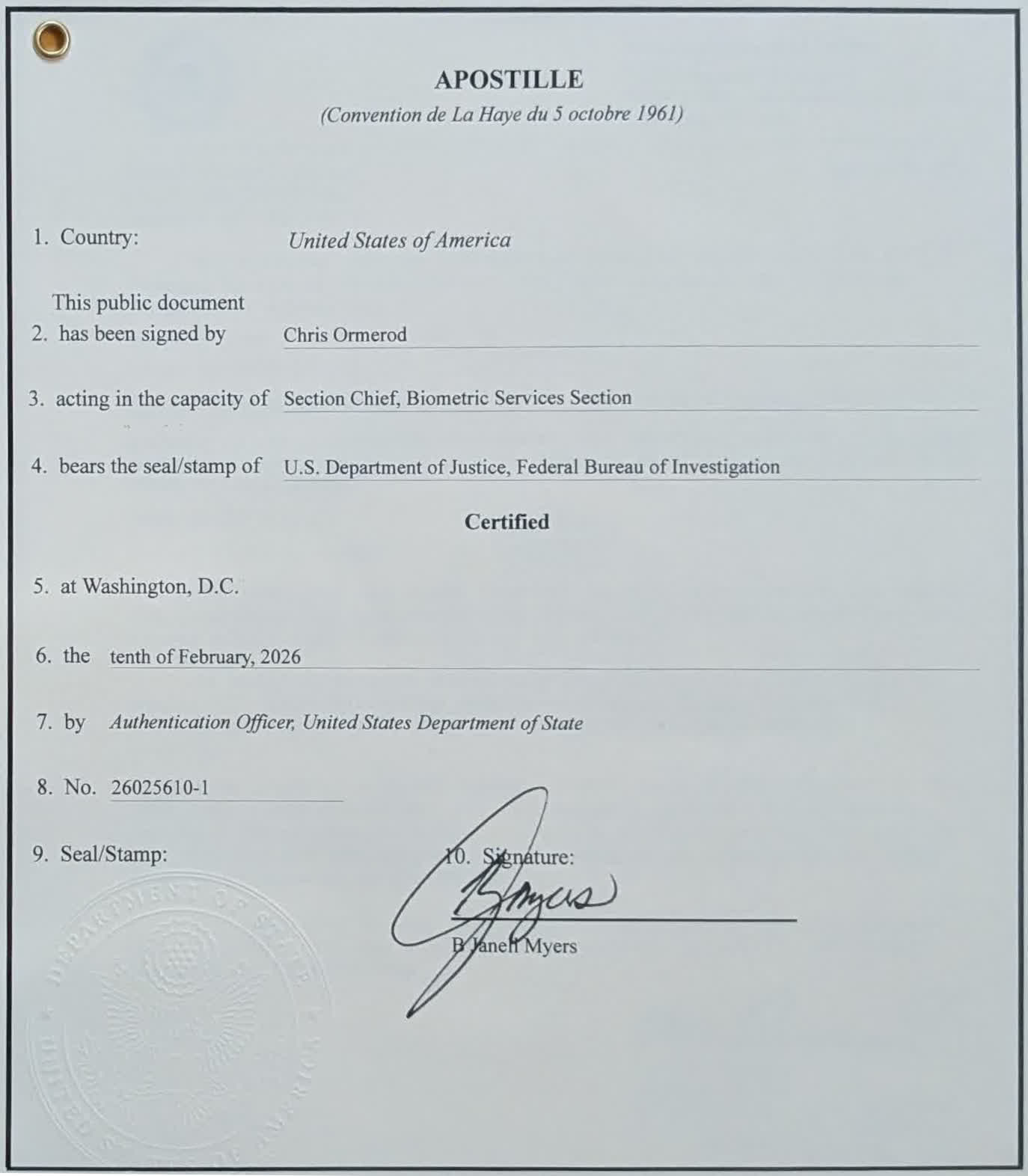
What Is a Federal Apostille?
A federal apostille is an authentication certificate issued by the US Department of State, Office of Authentications. It verifies that a document originated from a legitimate US federal agency and meets the requirements of the Hague Convention of 5 October 1961, making the document legally recognizable in any of the 120+ Hague member countries.
Federal apostilles differ from state apostilles in a critical way: they bypass all state and county certification steps and are processed entirely at the federal level.
Which Documents Require a Federal Apostille?
Any document that originates from a US federal agency must go through the federal apostille pathway. Common examples:
- FBI Identity History Summary (FBI background check / criminal history check)
- NARA certified copies – National Archives and Records Administration records, including naturalization records and military service records
- Certificate of Non-Existence (CoNE) – or any other signed correspondence from federal organizations
- Naturalization Certificate (Form N-550) and related USCIS documents
- Federal court orders, judgments, and apostilled court records
- Social Security Administration correspondence and certifications
- US Department of State certificates and official correspondence
- Federal agency certificates of good standing (for corporate use abroad)
If your document was issued by a state agency – such as a birth certificate, marriage license, or state-notarized document – it requires a state apostille instead.
How the Federal Apostille Process Works
Unlike state-level authentication, which may involve county and state offices in sequence, the federal pathway is centralized:
- Document originates from a federal agency (FBI, NARA, USCIS, SSA, federal court, etc.).
- Agency certification – the originating agency’s signature is on record with the Department of State.
- Department of State review – the Office of Authentications verifies the signature and attaches the apostille certificate or authentication embossing.
- Document returned with apostille affixed.
State Secretary of State offices have no jurisdiction over federal documents. Submitting a federal document to a state apostille office will result in immediate rejection.
Processing Times: Apostille50 vs. DIY
| Method | Typical Timeline |
|---|---|
| Apostille50 (standard rush) | ~2 weeks from receipt |
| DIY mail-in (Department of State) | 6–8 weeks |
We achieve faster turnaround by coordinating submissions directly with the Department of State and managing all routing steps in-house.
A Note on FBI Background Checks
FBI Identity History Summary (background check) documents are frequently issued digitally and may contain a digital signature. Because of this, FBI background checks can be submitted electronically – by email to info@apostille50.com or via the upload portal on the order confirmation page – rather than by physical mail.
For most other federal documents issued on paper with wet or embossed seals, physical originals must be mailed to us.
Pricing
Federal apostilles are $75.00 per document. If your order includes one or more state apostilles alongside a federal apostille, the standard $100 service charge applies to the entire order. For orders consisting only of federal apostilles, no service charge applies – you pay $75 per document and nothing else. To see the exact cost before checkout, use the Order tool.
When Legalization Is Required Instead
If the destination country is not a member of the Hague Convention – such as several countries in the Middle East, Southeast Asia, and sub-Saharan Africa – an apostille is not accepted. Instead, a full consular legalization process is required, which adds embassy authentication steps and typically additional fees. We handle legalization as well.
Frequently Asked Questions
What is a federal apostille?
A federal apostille is an authentication certificate issued by the US Department of State’s Office of Authentications. It verifies the origin of documents issued by US federal agencies – such as FBI background checks, National Archives (NARA) records, and federal court orders – so they can be legally recognized in Hague Convention countries without further authentication.
What documents require a federal apostille?
Documents that originate from a US federal agency require a federal apostille, not a state apostille. Common examples include FBI Identity History Summary (background check), National Archives and Records Administration (NARA) certified copies, federal court orders and judgments, naturalization certificates (Form N-550), US Department of State certificates, Social Security Administration correspondence, and federal agency certifications of good standing.
How long does a federal apostille take?
Apostille50 processes federal apostilles with standard rush service, typically completing authentication in approximately two weeks from the date we receive your documents. Standard DIY mail-in processing through the Department of State typically takes six to eight weeks.
How do I get an apostille on my FBI background check?
FBI Identity History Summary (background check) apostilles follow the federal pathway: the document is authenticated by the US Department of State’s Office of Authentications, not by any state Secretary of State. Because FBI background checks are often issued digitally, they can be submitted to Apostille50 by email or through the upload portal on the order confirmation page, rather than by mail.
Can a state office apostille a federal document?
No. A state Secretary of State office can only apostille documents that originate within that state. Federal documents – including FBI background checks and NARA records – must go through the US Department of State’s Office of Authentications. Submitting a federal document to a state apostille office will result in rejection.
